
Five buyers, one room and a simple message: story wins listings, but only if the numbers and the consistency of supply stand up behind it.
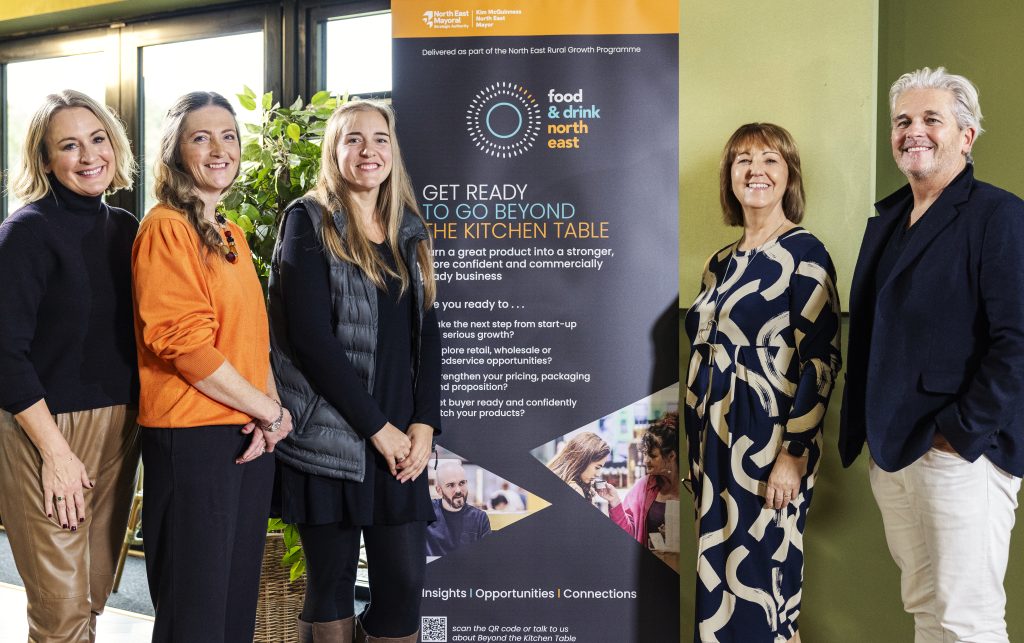
On 14th October 2026, producers, hospitality businesses and buyers gathered at Brocksbushes Farm Shop in Northumberland for Meet the Buyer: Live. The day was the final touchpoint of our Beyond the Kitchen Table programme, delivered through the North East Rural Growth Programme which is funded by the North East Mayoral Strategic Authority (North East MSA).
The morning, The Buyer’s Mindset, brought together five buyers from three very different routes to market: farm retail, national wholesale and the department store. Each gave an honest account of how they choose what goes on the shelf, what makes them say no, and what they need from the producers they work with. FADNE CEO, Chris Jewitt, facilitated the session and chaired the closing buyer panel. The afternoon moved to the marquee for a producer showcase and pre-booked one-to-ones between the Beyond the Kitchen Table cohort and the buyers.
Getting farm shop owners and decision makers, a national wholesaler and a department store buying team into one room, on one day, in front of the region’s emerging producers demonstrates Food and Drink North East’s ability to convene the region’s food, drink and hospitality sector.
As the North East’s farm-to-fork sector body, FADNE is the one organisation that works across the whole chain – growers, makers, wholesalers, retailers and hospitality – and joins the dots between them. Here is what we heard.
The farm shop view: local is the start, not the finish
Rachael Jewson of Knitsley Farm Shop opened with a point that set the tone for the day.
“Local is not enough on its own. A product has to taste right, look right and keep up with demand.”
RACHEL JEWSON, KNITSLEY FARM SHOP
She will not stock lines that compete with what the shop makes itself, such as cakes, bread, pies and soap. She will look hard at gaps the kitchen cannot fill, gluten-free being one.
On price, her advice was to explain it rather than defend it. Tell customers why your jam is £4.85 and not £1, and they will pay it.
She was candid that some lines fail for reasons nobody can predict. A chilli sauce everyone loved simply did not sell to her customers. A local chocolate brand, on the other hand, flew off the shelves, helped by simple, quality packaging. What she wants most is producers in-store doing tastings, and a new space opening for the Christmas fair will make room for more of that.
Natalie Wood from our hosts, Brocksbushes, showed how a growing farm shop protects its identity.
Two years into a new build, the business now sits somewhere between farm shop and food hall, and the team has written a product decision maker to keep everyone honest.
A product needs at least three “greens”: local; artisan or independent; meets a customer need the region cannot; enhances the quality offer; adds to margin rather than diluting it; and passes the office taste test.
More than one “red” – made outside the UK, sold in supermarkets, mass-produced or low welfare – and the question becomes whether a farm shop should be selling it at all.
“We prioritise quality over price. That’s a decision we’ve made.”
NATALIE WOOD, BROCKSBUSHES
She was clear on the numbers too. Brocksbushes generally works on around 40% margin, because staff wages alone account for 15-20%. A 25% wholesale margin does not keep the lights on. The shop has stopped apologising for prioritising quality over price, and the supermarket question matters for that reason: once a local brand lands in a multiple, the farm shop that backed it from day one ends up looking expensive.
The practical basics are non-negotiable. Products must be properly labelled and dated, and barcodes make life far easier at the back door. Shelf life shapes what is viable: a Scotch egg producer only made it onto the shelves once their date stretched to around five days, allowing one larger weekly delivery.
And if you know a seasonal gap is coming, say so early. A local lager that only brews in winter ran out mid-summer, and a forward order agreed in advance would have kept it on the shelf.
Natalie also urged producers to think beyond the shelf. Brocksbushes uses local products as ingredients in its café and restaurant, so a customer tries a chilli jam in a sausage roll at lunch and buys a jar on the way out – “a double bite of the apple”, as she put it.
The wholesale view: an enhancer with reach
Susan Justice from Bidfood was refreshingly direct. In a national wholesaler, local producers will “never be a driver, but an enhancer” – and customers now expect to see them. Bidfood buys on three things: quality, service and price.
The big news for the region is that Bidfood has piloted a regional range in Scotland and Wales, and the North East is confirmed as next. Their regional lead visits in November, with sessions for producers to follow in the new year.
The most common barrier Susan sees is a producer who has left no margin for a wholesaler. The answer is often logistics. Bidfood takes the slice of margin you would otherwise spend on delivery, and in return you gain access to a sales force of 16 reps on the road and a telesales team speaking to up to 2,000 customers a day. Her advice is to tell that sales team your story, and tell them again whenever it changes.
“Local producers will never be a driver, but an enhancer.”
SUSAN JUSTICE, BIDFOOD
She values producers who communicate and are transparent. Saying “we’re not ready yet” is fine, and for one producer it led to a forward sale. Bidfood will work at your pace, and SALSA accreditation is not an automatic barrier.
Her cautionary tale was a supplier who went cold after seven months of setup work. Her success story was a range of pies from a nationally renowned chef, now distributed across the region through Bidfood’s network.
The department store view: curation, newness and partnership
Fenwick brought two perspectives. Kieran McBride, Store Director at Fenwick Newcastle and a long-standing champion of local, explained that customers have told Fenwick they expect something new every week.
The store runs a local-first approach, and three new restaurants open in the next four weeks, taking the total to 18.
Kieran assesses every product through the senses – sight, touch, smell and taste – and through the story behind it.
Around 60% of non-fresh sales are gifts, which supports higher price points.
His challenge to producers was to think like the customer: what makes them stop, pick it up, pay and come back? Fenwick has data on the “magic price points” that work, and will back a full 360-degree launch when there is a story to tell. His trend tip for 2027 is take-home food you prepare yourself. Asked about the future, he was clear that “the local piece will never go away”, citing an 18-year relationship with a North Shields jewellery brand that started out on a market stall.
“Local, for me, will just continue and continue to grow.”
KIERAN MCBRIDE, FENWICK
Catherine Newton, who leads the buying team, explained why curation is everything. From the outside the food hall looks enormous; from the inside it feels tiny. There is only so much shelf space, and every square foot has to pay its way. Local brands sit alongside the leading names customers expect, enhancing the range rather than replacing it.
Her checklist was clear. Have a USP and be able to say why a Fenwick customer would choose you over what is already there. Walk the food hall before you pitch. Know your pricing – recommended retail, wholesale cost and margin – before you send a sample, because the moment a buyer picks up your product and asks the price is your moment. Bring newness through seasonal lines, limited editions or collaborations, as Fenwick has done with well-known regional brands and local brewers.
A strong hero product catches attention, while a range drives growth. Minimum orders can be as low as 24 units, provided repeat stock follows quickly.
“Tell your story. People definitely buy people.”
CATHERINE NEWTON, FENWICK
Most of all, she wants partners rather than stockists. One chocolate maker ran a teaser campaign ahead of the Fenwick window reveal and then posted the launch video on the Sunday night it went live. Fenwick sold 1,000 bars online before the shop even opened.
By contrast, a viral London brand that would not commit to visiting Newcastle saw its launch pulled on the day.
The partnership shows in the difficult weeks: communicate, keep the shelves full and come with solutions, not just a price list.
Her practical tip for getting noticed was simple. A short, to-the-point email, a sample with pricing, and a handwritten note in the box will stand a better chance at getting a response.
What tied the day together
Across five buyers and three channels, the same messages came through again and again.
- Story beats price – as long as you can explain the price. Customers pay for provenance, people and passion when they understand them.
- Know your numbers. Arrive with pricing and leave room in it for the channel, whether that is 40% for a farm shop or the delivery slice for a wholesaler.
- Be honest about what you can deliver. Consistency of product and supply matters more than size, and “not ready yet” is a respectable answer.
- A listing is the start of a partnership. The producers who succeed show up in store, on social and in the difficult weeks.
- Local enhances; it does not replace. Find the gap in the range and fill it brilliantly.
- Buyers are enablers, not blockers. When they say no, it is usually about space, resource or readiness, and readiness can be built.
We closed the panel by asking each buyer for one tip.
1. Be ready with your social media
2. Think beyond the launch and plan the year after.
3. Treat a pitch like a CV and tailor it to each buyers.
4. Have your scale-up plans ready.
5. Set your core values, do not deviate from them and know your worth.
Celebrating our Beyond the Kitchen Table cohort
The day belonged to this year’s Beyond the Kitchen Table cohort. Meet the Buyer: Live was the final touchpoint of their programme, and they made the most of it.
A huge well done to Alma Cacao, The Crackling Guy, Clara Nicholls Catering, Cakeaholics by Claire, Northern Sea Salt, Ewarts, DRYD, Cortijo Coracho and Meraki Cacao for your hard work, commitment and the learning journey you have been on together.
Over the past months, these producers have worked through the same questions the buyers raised on the day: pricing and margin, labelling and shelf life, supply and scale-up, and how to tell their story with confidence. In the morning, they led the table discussions and put their own questions to the panel.
In the afternoon, they took their place in the producer showcase and sat down for one-to-ones with the buyers in the room.
That takes commitment. Giving up a full day away from a small business is a real cost, and every member of the cohort chose to invest it in their growth. We are proud of how far they have come, and we look forward to watching where they go next – onto shelves, menus and wholesale lists across the region and beyond.
Thank you to every producer in the cohort for your energy, your honesty and your ambition.
Why the region needs one front door
Every buyer on the panel said a version of the same thing: they want to say yes to local, but their teams are lean and their inboxes are full.
Fenwick sees samples arrive almost every day.
Bidfood has spent seven months on a supplier who then went cold.
Farm shops juggle dozens of small suppliers and deliveries.
Buyers are not ignoring producers; they simply do not have the resource to incubate them.
That gap is where FADNE works.
Beyond the Kitchen Table takes producers through the stage gates buyers care about – pricing, margin, labelling, shelf life, supply and story – so that by the time a producer sits down with a buyer, both sides can be confident they are ready. Buyers get a trusted pipeline of investable local products. Producers get honest, specific feedback and a direct route to the people who decide what goes on the shelf.
No other organisation in the North East covers food, drink and hospitality from farm gate to plate. FADNE brings together producers, retailers, wholesalers, foodservice, hospitality, councils and funders, and carries the region’s voice nationally through a seat on DEFRA’s Food and Drink Sector Council. Whether you grow, make, buy, sell or serve food and drink in the North East, FADNE is the place to start.
What’s next
The conversations do not stop here.
Comply to Supply: Understand HACCP Growth Lab on 19th November. A full-day workshop for six to eight businesses, led by a regulatory expert, on turning HACCP into a living system rather than a document on a shelf. It will be one of the first events at FADNE’s new base. Places are limited and open to businesses registered on the Rural Growth Programme.
Brand, Positioning and Storytelling workshop in January 2027. For anyone asking whether their packaging and brand truly tell their story.
- We are already taking expressions of interest for our next Beyond The Kitchen Table programme which will run in early 2027.
Bidfood’s North East regional range. Their regional lead visits in November, with opportunities for producers to meet them in the new year. FADNE will help connect producers to that process.
Full details are on the events calendar on the FADNE website.
A huge thank you to Rachel, Susan, Kieran, Catherine and Natalie for giving up their time so generously, to Brocksbushes for hosting, and to every producer who gave up a full day of their business to be in the room. Building the bridge between what you make and what buyers need is exactly why FADNE exists – and if you are not yet part of that conversation, get in touch.
